;)
The AI Reckoning Most DMOs Aren’t Ready For Yet
I get it. You’re already juggling a content calendar, a board presentation, a visitor guide refresh, and one of your bureau members is mad because they weren’t tagged in a Facebook post. AI, even if you’re interested, feels like something to deal with later, once the picture is clearer. The problem is that the organizations waiting for clarity are the ones who will spend the next decade wondering why organic traffic keeps dropping without an obvious explanation.
This is something I’ve been hearing more of, especially in the last 8 months, and while AI might cause people to sprain their eyes from rolling them so hard, it’s still important to understand what’s going on. More important, especially for rural DMOs, is prioritizing a plan to prepare for what’s coming.
The Discovery Sequence Is Breaking
For years, we’ve understood how travelers find us: search engines, DMO websites, TripAdvisor, a travel blog, social media, and so forth. DMOs built their entire digital strategy around capturing attention at predictable points in that chain. As I’ve mentioned before, AI is dismantling the chain itself.
People can now pop into Claude, Perplexity, or Gemini, describe what they want, and get an itinerary. The DMO website may never enter the picture. That’s not hypothetical; it’s happening at scale today and accelerating as users increasingly trust AI recommendations.
The specific problem for places like rural Pennsylvania is data weight. The major metros like Philadelphia, Pittsburgh, etc. have enormous digital representation: reviews, articles, structured listings, Wikipedia depth, years of social content. Most rural regions have a fraction of that. In an AI-mediated discovery environment, that asymmetry doesn’t just persist; it amplifies.
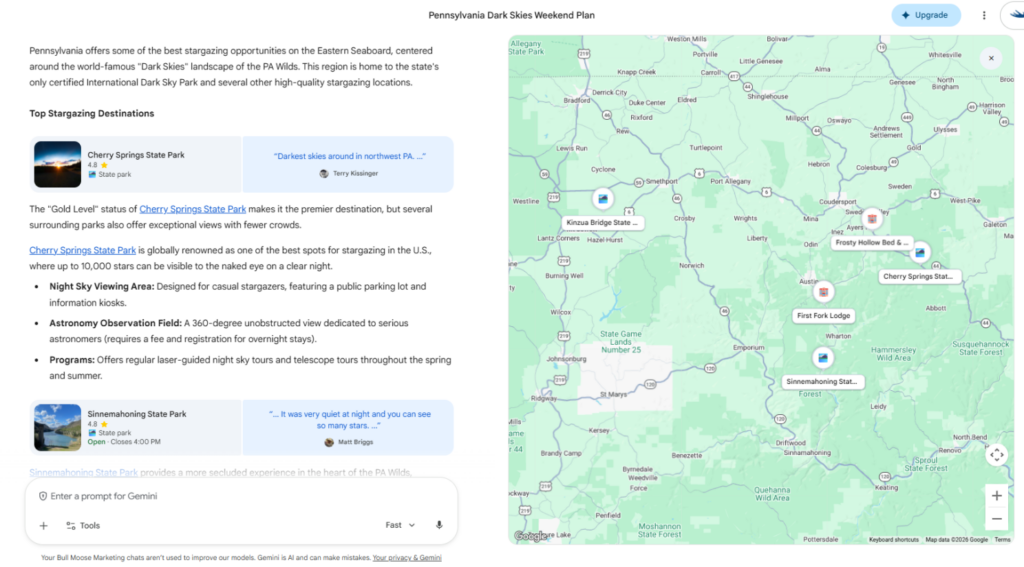
Ask an AI to plan a dark sky weekend in Pennsylvania, and you’ll get Cherry Springs and Sinnemahoning State Park because those places are well-documented in the AI’s knowledge layer. Many of the best places for getting lost in The Great American Getaway are not, and worse, what is out there from third-parties or old sources will translate into inaccurate AI outputs. (If my dad just drove 45 miles during a vacation in God’s country for some soft serve only to discover it closed two years ago, Lord help us all.)
Rural DMOs that haven’t actively built their AI presence will experience this as a slow erosion of visibility that looks, from the inside, like declining web traffic without an obvious cause. The cause will be structural, and it will be very hard to reverse late in the game.
Personalization Is The Prize
DMOs have always known, at least conceptually, that their audience isn’t monolithic. A birder, a mountain biker, and a couple planning an anniversary weekend all land on the same regional website but need different things. The traditional response has been microsites, persona-based content hubs, itinerary landing pages — all of which require significant production investment and still reach the visitor as a category, not as a person.
AI changes this equation entirely. Personalization is the Holy Grail every travel app and booking site strives for. This is now within reach for small DMOs, provided they have structured experience data that then forms an engine for genuinely personalized recommendations, matching a visitor’s activity preferences, physical capability, travel party, and available dates to specific itineraries, lodging, and experiences in real time. The DMOs with rich, granular, machine-readable data about their experiences will participate in that system. (Hint: start tracking this now and ditch the PDFs of seasonal brochures. Tracking a download without context is worthless here, plus AI will ignore them and your site in search results.)
For a state tourism office, this has implications for how it can reevaluate its own role. This is getting into the weeds, but building a statewide tourism knowledge layer isn’t just a search visibility play, it’s an opportunity to be the authoritative data source that AI personalization systems draw from. If a state tourism office doesn’t own that position, some other platform with different incentives will. That’s a viable competitive threat and lost visitor spending.
The Content Flood Is Already Here
AI-generated destination copy saturates every channel, and a lot of it will come from DMOs who think they’re using AI efficiently. That’s a trap. Generic content isn’t just low-value in an AI environment, it’s actively counterproductive, because AI systems are increasingly trained to recognize and deprioritize thin, synthetic material. Rather ironic when you think about it.
Authenticity in the age of AI will be a premium. The hard work that goes into creating specific, place-grounded content will become more valuable, not less. First-person narratives from actual guides at Elk Country. Verifiable details about what elk rut looks like in the second week of September versus late October. The name of that café in Wellsboro that opens at 6am for photographers coming off Cherry Springs. That level of specificity is hard to fabricate and hard to replicate. AI systems being optimized for high-trust answers will weight it accordingly.
DMOs that use AI to handle production volume while doubling down on authentic, place-specific knowledge as their differentiated layer will be in better shape than those outsourcing the entire content function. The shortcut isn’t a shortcut.
Organizational Disruption Is Real and Unplanned For
Some DMO roles are going to be substantially reshaped. Content production, basic visitor inquiry response, and standard research tasks will increasingly be handled by AI or significantly assisted by it. For a three-person rural DMO, that could mean genuine capacity gains — or it could mean budget pressure to cut headcount before the organization has developed the skills to use AI strategically. Managing that transition well is an active leadership decision, not something that sorts itself out later.
What grows in value is the capacity to manage data, maintain AI systems, direct AI effectively, and interpret AI-generated outputs critically. Most Pennsylvania DMOs don’t currently hire for those skills and don’t have the budget to attract them easily. This points toward the opportunity for a shared services model — a regional DMO or the state tourism office providing shared AI infrastructure, data standards, and training that individual small DMOs can’t afford to build independently. It’s the same logic that drives shared marketing co-ops, applied to a different layer of the operation.
There’s a Measurement Problem
This one’s underappreciated, and it’s going to create real institutional pain. DMOs currently quantify a portion of their success through web analytics: traffic, sessions, visitor guide requests, referral conversions. As AI absorbs more of the discovery process, those metrics will decline structurally regardless of whether the destination is actually performing well. A traveler who asks an AI to plan a Lake Erie trip and then drives to Presque Isle never generates a pageview that can be counted.
New measurement frameworks have to be developed — AI citation tracking, brand mention monitoring in AI outputs, visitor intercept research that asks directly how the trip was discovered. The organizations that get ahead of this, that can demonstrate that AI visibility is translating to economic impact even when web traffic is flat, will be in a much stronger position than those defending budgets based on Google Analytics dashboards that are declining for reasons nobody can explain.
What to Actually Do
Even if you’re onboard with all the above, we know this won’t happen overnight. I’ve been around long enough to know that just getting stakeholders to act on something they can’t fully see yet will take serious effort. That said, I think a realistic window for building a structural advantage here is roughly three to five years. It’s short enough that decisions made now are consequential, but long enough that organizations with modest resources can actually make progress if they start now rather than waiting for clarity that isn’t coming.
At a state level AI readiness should be viewed as an infrastructure investment: data standards, knowledge architecture, authoritative sourcing relationships with AI platforms. For regional DMOs (or DMOs working cooperatively within a region), this would mean auditing what structured, machine-readable data actually exists about their destinations and then starting to fill the gaps. For both, it means developing internal capacity to manage and direct AI rather than just consume it.
I’m still looking but thus far, there are very few documented, replicable models for rural destination AI readiness anywhere in the country. This is likely because it’s so new, and AI is moving faster than organizations can digest the implications. A coordinated regional initiative, involving a network of rural DMOs working on a shared framework is the right size–a sizable chunk of visitor experiences, but not too big to manage. That then becomes proof of concept that can be replicated, cited, and built on at a larger scale.
I’ll finish by acknowledging that things may look very different in 3 to 5 years. Part of AI’s disruption is the uncertainty in trying to guess what it’s going to change next. What do you shoot for when the target keeps moving? My only answer comes from my Army days. Do something, even if it ends up being wrong, because the worst thing to do is doing nothing at all. Whatever happens, the DMOs that do something now will still be better positioned than those who opted to do nothing at all
AI Disclosure: The ideas and writing came from my brain. Claude Sonnet 4.6 helped with research and correcting my grammar. The header image was generated by ChatGPT 5.4 (and yes, we have graphic designers on staff, but they stay focused on paid client work and not my personal drivel.)