;)
There’s a version of this story that sounds almost…reassuring. AI is complicated, expensive, and mostly a concern outside the realm of our control. Data centers overloading the grid, stealing from artist, a deluge of AI slop in my Facebook feed – eh. It doesn’t affect me, not really. And besides rural communities have survived disruption before — factory closures, population loss, the slow retreat of federal investment. We’ll figure this one out too.
That narrative is wrong, and the window for proving it wrong is shorter than most people realize.
What’s unfolding isn’t a single technology trend. It’s a convergence of pressures hitting rural communities at the same time, and AI literacy and adoption, whether as a matter of refusal, apprehension, access, or its overwhelming nature, is the critical throughline for nearly all of it.
People say all the time, “I don’t have time for one more thing.” This is the one-more-thing we as rural communities need to pay attention to for more than a few reasons.
Manufacturing: The Most Immediate Exposure
Start with manufacturing, because that’s where the exposure is most immediate. Pennsylvania’s manufacturing sector accounts for 13% of state GDP, and the “Factory of the Future” model now explicitly requires the integration of AI, IoT, and connected data systems across the supply chain. Tier 1 and Tier 2 suppliers who can’t interface with that infrastructure don’t just fall behind competitors. They become operationally incompatible with their own customers.
There are Pennsylvania programs — SMART-PA, the state’s Manufacturing Extension Partnership network, the Innovative Manufacturers’ Center in central PA — already trying to close this gap. The problem isn’t that resources don’t exist. It’s that too many rural manufacturers aren’t engaging with them before contracts dry up. Waiting until this happens will be too late.
And it’s not just manufacturing. AI is going to replace jobs. A lot of them, and people, in a wide range of roles need to start looking at how to future-proof what they do.
(Update: the day after I published this, the US Department of Labor launched a free 1-week AI literacy course called Make America AI-Ready designed to ensure every American worker has the chance to learn the foundational skills to benefit from AI.”)
Workforce: The Pipeline Is Already Showing Cracks
The workforce feeding those facilities is in trouble too. At a recent Pennsylvania Senate hearing, Luzerne County Community College President John Yudichak cited a state Department of Education report projecting a shortage of 218,000 Pennsylvania workers by 2032 who will lack the post-secondary credentials and skills the job market will require, with a current skills gap of 12,200 workers in the trade and maintenance cluster alone.
Community colleges across the state are beginning to respond — Pennsylvania Highlands, CCAC, and Community College of Philadelphia all offer AI and machine learning training, and PennWest University launched a formal Center for Artificial Intelligence and Emerging Technologies in 2024, with its director testifying at a Pennsylvania Senate hearing on AI in education and workforce development. The infrastructure for training is being built. The question is how to scale up access for rural students and workers — and whether the trade and technical schools serving rural communities will treat AI integration as core curriculum rather than an elective concern. (Note: One good resource is the Pennsylvania Training and Technical Assistance Network’s AI Toolkit)
K–12 Schools: Competing Without Realizing It
Schools at the K–12 level face the same reckoning. Parents making enrollment decisions are increasingly asking whether a district is preparing students for the workforce they’ll actually enter. Across rural America, the AI divide is deepening the gap between students with access to advanced tools and students who still struggle with basic internet connectivity.
Districts that don’t weave AI literacy into how students read, write, reason, and solve problems — not as a technology class, but as a critical-thinking competency — will lose enrollment to those that do. In communities where school funding is tied directly to enrollment, that’s not abstract.
Healthcare: A Lifeline Being Left on the Table
Local healthcare is already in crisis, and AI is a practical tool that rural hospitals are leaving on the table. Pennsylvania health officials project that roughly 25 rural hospitals — about a third of the state’s rural facilities — could close within the next several years.
The American Hospital Association published findings earlier this year showing that rural hospitals adopting AI in targeted ways — revenue cycle management, clinical documentation, care coordination — are demonstrating stronger operational resilience than those that aren’t. These hospitals are using AI as an operational enabler, starting where impact is immediate and investment requirements are modest, without requiring enterprise-wide overhauls. For facilities already operating at a loss, this isn’t futurism. It’s the gap between staying open and becoming another statistic.
Local Journalism: The Information Vacuum
The journalism situation is harder to fix and arguably more dangerous in its downstream effects. There are now more than 210 U.S. counties with no locally-based news source at all, and nearly 80% of news deserts are in counties the USDA classifies as predominantly rural. Pennsylvania is directly in this trend and not just small rural reporting either. The Pittsburgh Post-Gazette announced earlier this year it will cease operations in May 2026.
When a local newspaper closes, civic engagement falls, corruption increases, and communities become more vulnerable to “pink slime” sites — outlets that masquerade as local news while amplifying misinformation. Local newsrooms that use AI to stretch limited staff — for transcription, data analysis, routine coverage of public records — can cut costs and save time without sacrificing journalistic integrity. Those that don’t, won’t. And communities already operating in low-news environments will end up with lower-quality AI-generated information and higher exposure to misinformation, because AI systems without sufficient local data tend to fill gaps by scraping social media rather than verified sources.
Personally I see this as one of AI’s greatest hidden dangers: AI-generated misinformation which would only compound what we already have seen happen through social media.
The Compounding Cycle
None of these pressures operate in isolation. They compound. When a hospital closes, jobs disappear. When jobs disappear, population drops. When population drops, school enrollment falls, small businesses lose customers, and municipal revenues shrink. In Rust Belt communities that lost anchor employers, young people have already left, and the residents who remain have grown frustrated over diminished prospects. AI illiteracy doesn’t create that cycle — but it accelerates it, because it affects all aspects of our daily lives while removing the traditional approaches that might otherwise slow the cycle.
In a nutshell, this is what makes AI different from everything else. The ways in which AI is being applied and how are fast and far-reaching. It’s the most consequential technological advancement since probably the wheel. But AI’s not the boogeyman, or it doesn’t have to be if rural communities learn to harness its capabilities to their advantage. Where, then does this start?
What Can Actually Be Done
There is more than one approach here, but given AI’s reach across typical rural governmental and organizational structures, having a focal resource would be the easiest option. For example, designating a regional AI coordinator — someone housed within an existing regional planning commission or economic development organization — can help municipalities, schools, manufacturers, and healthcare providers understand AI’s applications, find AI tools, and coordinate efforts like data structuring across entities. Beyond this, a regional AI coordinator would be responsible for helping develop strategies meant to leverage AI to a region’s advantage. In some cases a role like this could function at a county level in cases where capacity and resources allow; however, a regional model is more durable and more likely to survive budget cycles.
But the need for AI literacy extends to the individual level as well. In some respects, here’s where it might be the most consequential. While Pennsylvania does offer an AI and Digital Media Literacy resource page, there is more work that needs to be done at the local level.
Public libraries would seem to be the right anchor for general AI literacy. They’re trusted, accessible, and already structured for community programming. Teaching residents how to use AI tools critically — and how to recognize when AI is being used to mislead them — belongs in the same category as financial literacy and civic education. It should be treated that way.
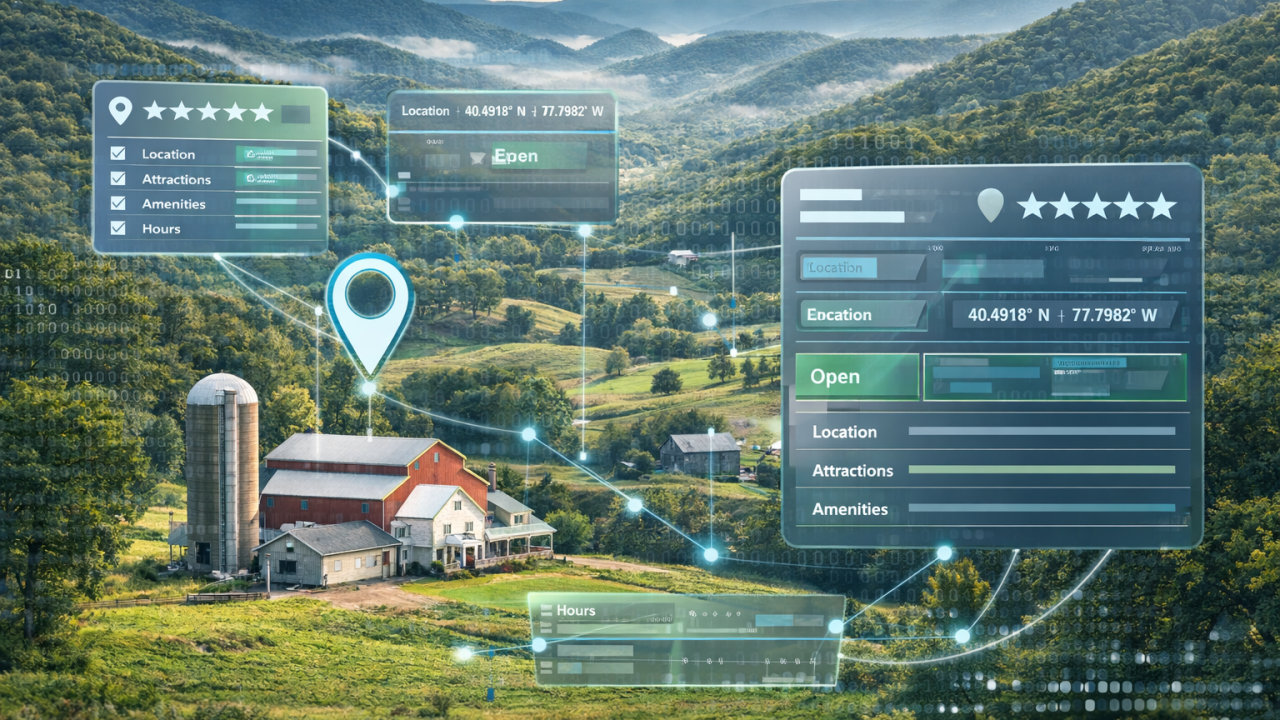
The things AI genuinely cannot replace — the local craftsperson, the independent restaurant, the trail network, the heritage experience — still need AI to be competitive. These assets need to be discoverable, marketable, and economically viable in a digital economy. The argument for protecting them is inseparable from the argument for helping them adapt.
The communities that came through the last wave of industrial disruption in the best shape were the ones that invested in adaptability rather than waiting for conditions to stabilize. Research on global Rust Belt recovery found that cities with higher shares of college-educated workers were far more likely to recover from manufacturing loss, and that U.S. communities fared worse than their international counterparts largely because of workforce education gaps. That pattern didn’t start with AI, and it won’t end with it. The point being: AI education at every level is the key here.
The choice in front of rural Pennsylvania communities isn’t between AI and tradition. It’s between engaging with change on their own terms vs having change imposed on them by the decisions of others. I heard someone once say that people don’t fear change; they fear being changed. AI has changed things. It will continue to do so regardless of anyone’s feelings. The rural communities that get past this fear and face the change will avoid becoming a victim to it.
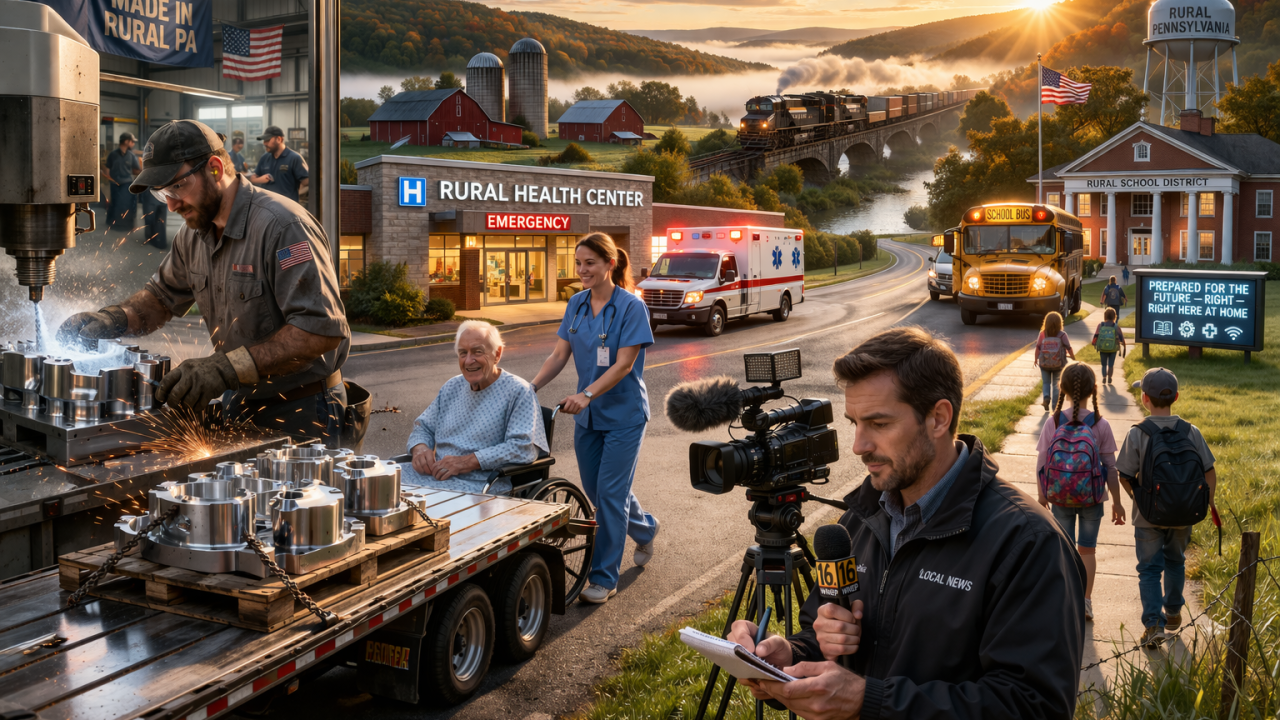
AI Disclosure: The ideas and writing are mine. Gemini Deep Research and Claude Sonnet 4.6 were used for research and development. The header image was generated by ChatGPT 5.4 (and yes, we have graphic designers on staff, but they stay focused on paid client work and not my personal drivel.)